
The Kingdom
Kings and Prophets
How to read the timeline
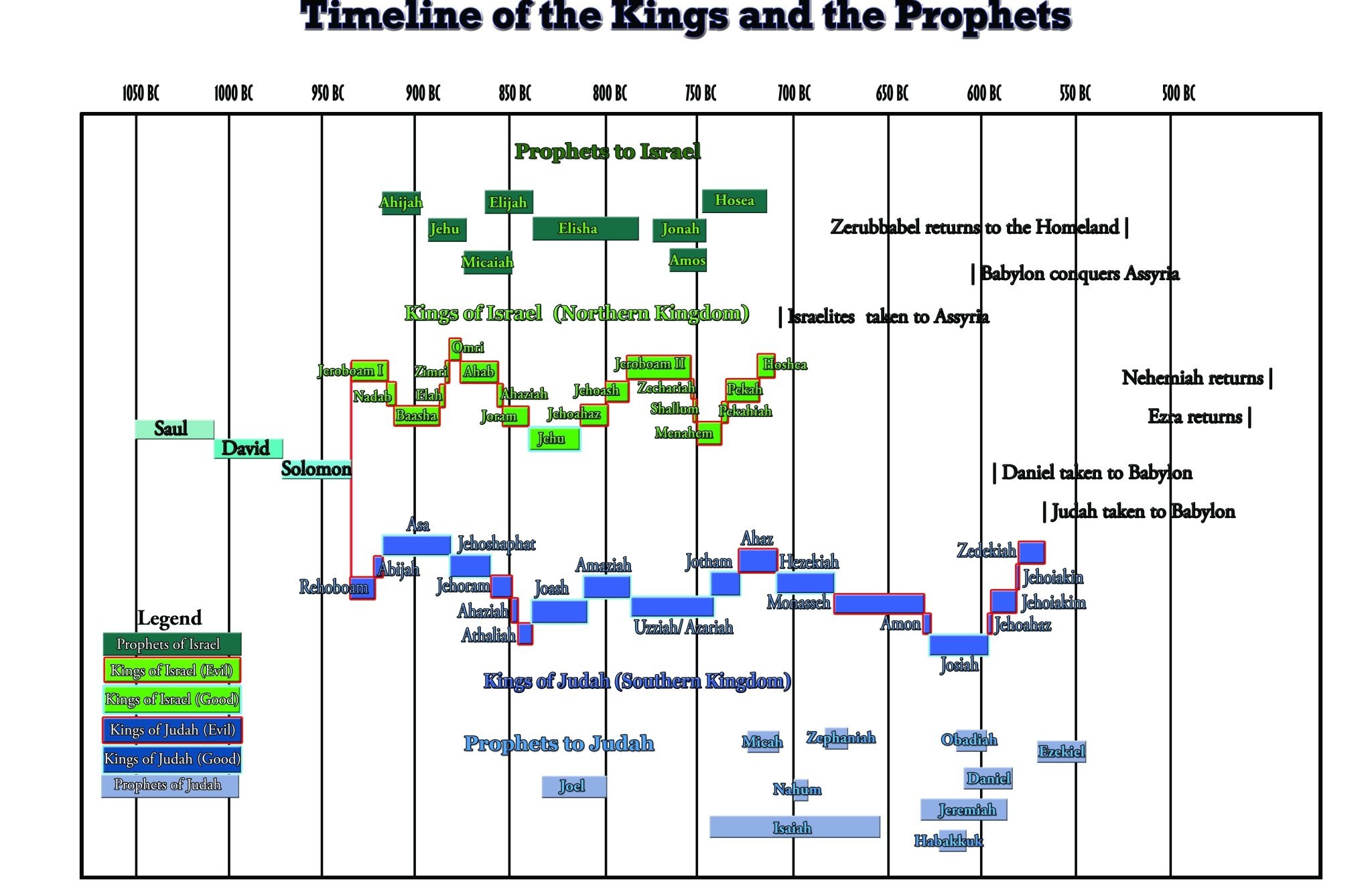
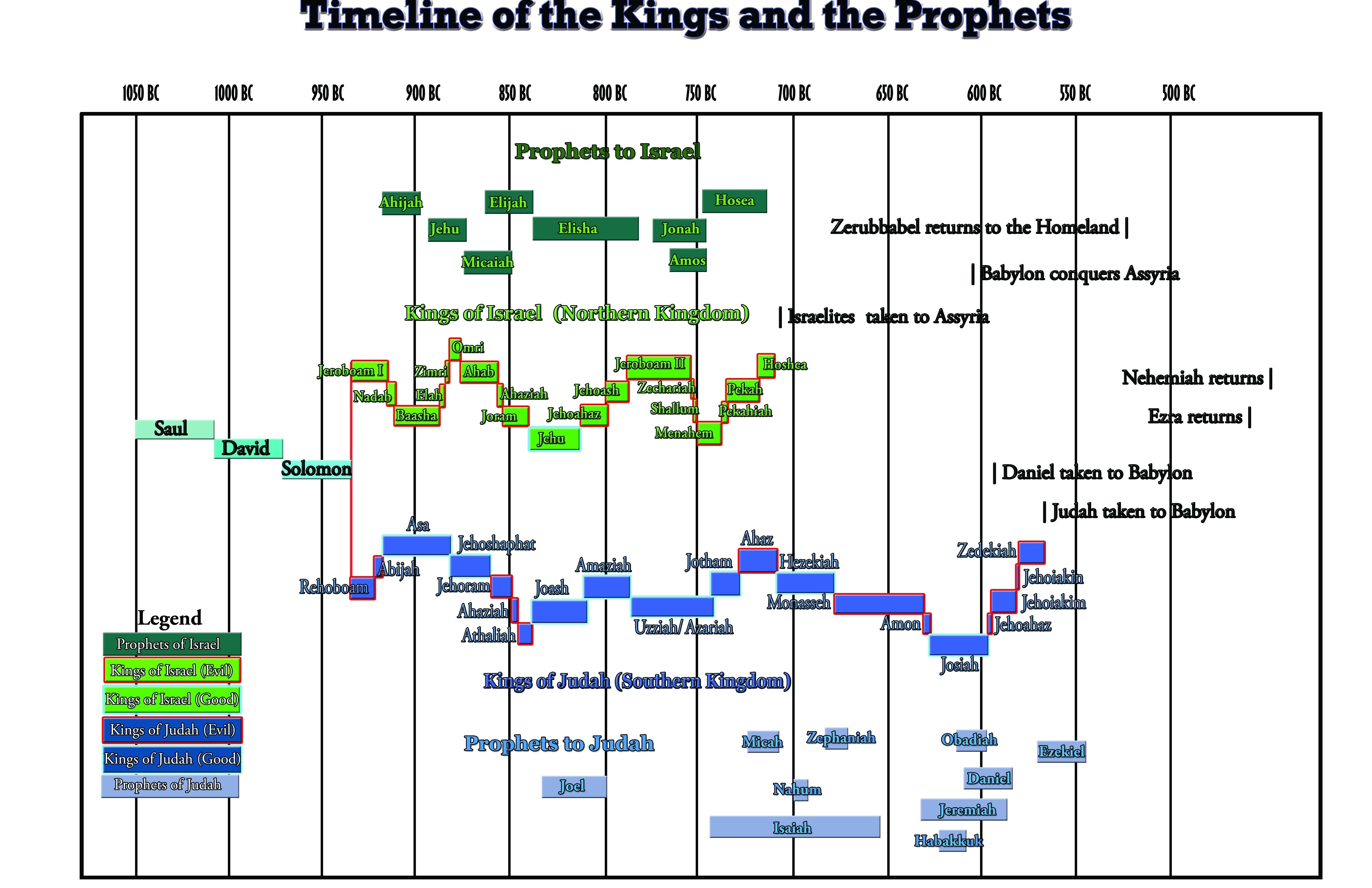
Two columns of kings running side by side, with the prophets laid against them.
This chart is worth more than it first appears. The prophetic books give you a man and a message but rarely a date, and this is what places them. Isaiah belongs to the reigns of Uzziah through Hezekiah; Micah is in the villages of Judah at the same time; Amos speaks under Uzziah and Jeroboam the second; Hosea is sent to the north. Find your prophet here before you read him, and you will know who he was shouting at.
A note on the translation. Most of this study quotes God’s Word. On this page the quotations are from the Legacy Standard Bible, and the links open there too. It is a more literal translation, and two things it does are useful here: it keeps the older, harder words the prophets actually used — woe, crush, leprosy — and it prints the covenant name of God rather than replacing it. If you prefer to read alongside God’s Word, change the version in the drop-down at the top of any passage you open.
How the chart is laid out
Down the middle run the kings. Above them are the prophets sent to Israel, the ten northern tribes; below them the prophets sent to Judah in the south. The kings are colored, and the color is a verdict. Along the right-hand side are the great turning points — Israel taken to Assyria, Judah taken to Babylon, and then the three returns under Zerubbabel, Ezra and Nehemiah.
Read it slowly the first time. The shape of the whole kingdom period is in it, and once you have that shape in your head every prophet you open afterwards has somewhere to sit.
The same thing, set out in order
Here is the kingdom period set out as a table, reign by reign — searchable, readable aloud by a screen reader, and legible on a telephone. The books give no BC dates, so these follow the standard reconstruction, and where a king was one thing and then another he is marked mixed rather than forced into a color.
| Years BC | Israel — the north | Judah — the south | Prophets at work |
|---|---|---|---|
| 930–909 | NorthJeroboam I Evil — sets up the golden calves | SouthRehoboam Mixed · Abijam Evil · Asa begins Mixed | ProphetsAhijah |
| 909–885 | NorthNadab · Baasha · Elah · Zimri All evil | SouthAsa Mixed — a reformer who ended by jailing the seer | ProphetsJehu son of Hanani |
| 885–853 | NorthOmri · Ahab Evil — Baal made the state religion | SouthAsa · Jehoshaphat Mixed — good, but married his son into Ahab’s house | ProphetsElijah · Micaiah |
| 853–841 | NorthAhaziah · Joram Evil | SouthJehoram · Ahaziah Evil | ProphetsElijah · Elisha |
| 841–814 | NorthJehu Mixed — tore down Baal and the house of Ahab, kept the calves | SouthAthaliah Evil · Joash Mixed | ProphetsElisha |
| 814–782 | NorthJehoahaz · Jehoash Evil | SouthJoash, then Amaziah Mixed — both began well and did not end well | ProphetsElisha, to about 796 |
| 793–753 | NorthJeroboam II Evil — the widest borders and the greatest wealth the north ever knew | SouthUzziah Mixed — strong and prosperous, until he took the censer | ProphetsJonah · Amos · Hosea begins · Joel † |
| 753–732 | NorthZechariah · Shallum · Menahem · Pekahiah · Pekah All evil — five kings in twenty years, four of them murdered | SouthJotham Good | ProphetsHosea · Isaiah from 740 · Micah from about 735 |
| 732–715 | NorthHoshea Evil — Samaria falls, 722. The northern kingdom ends. | SouthAhaz Evil — shut the temple, burned his own son | ProphetsHosea · Isaiah · Micah |
| 715–686 | NorthGone. Assyria settles other peoples in the land. | SouthHezekiah Good — opened the temple again and broke the high places | ProphetsIsaiah · Micah |
| 697–640 | North— | SouthManasseh Mixed — the worst of them all, and he repented in captivity · Amon Evil | ProphetsNo prophetic voice recorded — the longest silence of the period |
| 640–609 | North— | SouthJosiah Good — repaired the temple, found the book of the law, tore his clothes | ProphetsZephaniah · Huldah · Jeremiah from 627 · Nahum |
| 609–587/586 | North— | SouthJehoahaz · Jehoiakim · Jehoiachin · Zedekiah All evil — Jerusalem falls, 587 or 586. | ProphetsJeremiah · Habakkuk · Daniel, from Babylon, taken 605 · Ezekiel, from Babylon, called 593 |
| 587/586–538 | North— | SouthNo king. The people are in Babylon. | ProphetsJeremiah, then Lamentations · Ezekiel · Daniel · Obadiah |
| 538–430 | North— | SouthThe returns — Zerubbabel 538, Ezra 458, Nehemiah 445 | ProphetsHaggai · Zechariah · Malachi |
† A note on Joel. He is the one prophet whose date is genuinely unsettled. His own book names no king, and the argument has to be made from the inside — the farming background, and how closely his language sits beside Hosea and Amos. That is why he is placed here, in Uzziah’s reign. Others read him as the earliest of all the writing prophets, a century and more before this, and the chart above does not take that view. Read him and judge for yourself; nothing in his message depends on it.
Two things stand out once it is set down in rows. The northern kingdom never produces a good king in two hundred years — nineteen men, and the best that can be said of any of them is mixed. And the prophets do not appear evenly. They come in clusters, and they fall silent for the fifty-five years of Manasseh, when there was most to say.
Two different measures
Here is the key to the chart, and it is worth pausing over, because without it the colors will confuse you.
There are two ways to judge a king, and they do not give the same answer. You can ask what his reign did for the nation — were the borders safe, was there bread, did the kingdom hold together. Or you can ask what he did with the covenant — did he keep faith with the God who had made this people a people at all.
The colors on the chart lean toward the first question. The prophets ask the second. And the gap between those two answers is not a fault in the chart. It is the whole burden of the prophetic books.
Understand that, and a great deal falls into place. A king could hold the land and lose the covenant. A nation could be prosperous and rotten at the same time. The prophets were sent precisely because nobody could see the difference.
Why the prophets cluster where they do
As you read down the timeline, God’s approval of a king tracks one thing — his obedience to his calling as king. He was to rule recognizing that he served under THE King, which meant his reliance was on God’s protection and blessing, not on the number of his horses and chariots (Deuteronomy 17:16).
The nations around them worshipped idols much like the ones Israel had lived among in Egypt — a god for everything: rain, crops, weather, and on. They had high places, where the worship of those gods was carried on. God’s measure of a king was whether he called the people back to the worship of the one and only God, or whether he let the high places continue in their course. When idol worship continued, the nation suffered, and the people in it suffered.
And so God sent the prophets — to remind the king and the people whose they were, and to warn that judgment always follows forsaking God.
Look at where the prophetic bars bunch together and you will notice they gather around bad kings. That is the obvious reading, and it is true as far as it goes. Elijah and Elisha stand against Ahab and Jezebel. In Judah the prophets thin out under the good kings and crowd in under Ahaz and Manasseh.
But look more carefully, because there is a second pattern, and it is the more searching one.
The northern kingdom’s finest hour came under Jeroboam the second. The borders were wider than they had been since Solomon, the trade was good, the houses were fine. By every measure a nation uses, it was a success. And that is exactly the reign into which God sent Amos and Hosea.
Read what Amos actually attacks. Not defeat — comfort. Those who lay down on beds of ivory and sprawl on their couches 6:4. Woe to those who are at ease in Zion, and to those who feel secure in the mountain of Samaria 6:1. The women he calls the cows of Bashan, who oppress the poor, who crush the needy 4:1.
So the prophets do not only come when the nation is suffering. They come when it is comfortable and has stopped noticing. Judged on the first measure Jeroboam’s reign was the best the north ever had. Judged on the second it was the moment God said the account had run out. Within a generation Samaria fell.
The kings were mixed, as we all are
The chart has to choose a color, and life does not divide that neatly. Several of these men were both things at once.
Jehu is the clearest case. He tore down the house of Baal and swept away the house of Ahab, and this is what was said to him: And Yahweh said to Jehu, “Because you have done well in doing what is right in My eyes, and have done to the house of Ahab according to all that was in My heart, your sons of the fourth generation shall sit on the throne of Israel” 10:30.
Yahweh is the covenant name of God — the name He gave to Moses at the burning bush, the name by which He bound Himself to this people. Most English Bibles put the LORD in capitals wherever it stands. It is worth seeing the name itself here, because everything on this chart is measured against the covenant that name was given in.
That commendation is real, and no other northern king receives one. The dynasty Jehu founded lasted about ninety years, five kings, the longest and steadiest line the north ever had.
And in the same chapter: as for the sins of Jeroboam the son of Nebat, which he made Israel sin, from these Jehu did not depart, even the golden calves that were at Bethel and that were at Dan, and Jehu was not careful to walk in the law of Yahweh, the God of Israel, with all his heart 10:29, 31. Hosea would say it more sharply still: I will visit the bloodshed of Jezreel upon the house of Jehu 1:4. And his own reign lost ground — in those days Yahweh began to cut off portions from Israel, Hazael striking them throughout the territory east of the Jordan 10:32–33.
Obedient in the demolition, unreformed in the worship. Good for the nation, and still holding on to the calves. Both are true.
He is not alone in this. Asa was a good king who was vexed with the seer and put him in prison for telling him the truth 16:10. Jehoshaphat was a good king who married his son into the house of Ahab. Joash was faithful while old Jehoiada lived, and then had Jehoiada’s own son stoned to death in the court of the house of Yahweh 24:20–22. Uzziah was a good king until he carried the censer into the temple: when he became strong, his heart was so proud that he acted corruptly, and the leprosy broke out on his forehead 26:16–21.
And the movement runs the other way too. Manasseh is the blackest name on the chart, the king who filled Jerusalem with innocent blood. Yet in his captivity he entreated Yahweh his God and humbled himself greatly before the God of his fathers. Then he prayed to Him, and He was moved by his entreaty and heard his supplication 33:12–13.
So take the colors as a summary and not as a soul. Even the king God commended kept the calves; even the worst king repented.
The same turn, twice
Judah’s history turns on the same hinge two times over, and the prophets are standing at both hinges.
The first is Ahaz to Hezekiah. Ahaz shut the doors of the house of Yahweh and burned his own son; Hezekiah opened them again and broke the high places in pieces. Isaiah and Micah are preaching straight through that turn.
The second is Manasseh and Amon to Josiah. Fifty-five years of the worst of it, then a boy king who repaired the temple, found the book of the law in it, and tore his clothes when he heard what it said. Zephaniah is preaching in the early days of that reign, and Nahum, Habakkuk and Jeremiah follow close behind him.
Notice which way the causation runs. Zephaniah did not merely watch Josiah’s reform; his words helped to wake it. The prophet stands at the hinge between a wicked father and a righteous son, and pushes.
Daniel, taken out early
Judah went to Babylon in stages, and this is easy to miss. Daniel and his companions went in the first deportation, years before the city fell, and they did not go by accident.
Nebuchadnezzar’s instruction was precise: bring some of the sons of Israel, including some of the royal seed and of the nobles, youths in whom was no defect, who were good in appearance, showing insight in every branch of wisdom … and who had ability to stand in the king’s palace 1:3–4. He was not taking slaves. He was taking the next generation of leadership out of Jerusalem before it could lead. Remove the royal seed and the capable young men, and what is left behind will not rise again.
Which means Daniel writes his whole book from outside. He is in the palace of the conqueror, in office, watching from Babylon while his city is besieged, starved and burned. He reads Jeremiah there — I, Daniel, discerned in the books the number of the years concerning which the word of Yahweh came to Jeremiah the prophet for the fulfillment of the laying waste of Jerusalem, namely, seventy years 9:2 — and then prays one of the great confessions of Scripture over a ruin he cannot see, for Your city Jerusalem, Your holy mountain, become a reproach to all those around us 9:16.
He grieves for Jerusalem as truly as Jeremiah does. He simply does it from a thousand miles away, in a foreign court, having been taken out early because of who his family was.
Where the two measures finally agree
For four hundred years the two verdicts disagreed. The nation could look well and be faithless. That gap is what every prophet on this chart was shouting into, and almost nobody listened, because on the measure that people use things seemed tolerable enough.
Lamentations is the book in which the gap closes.
The verses that say so — and the one place in the middle of the book where hope breaks through — are on the Lamentations page, where they belong. This chart is what makes them land.
The covenant measure had condemned the nation for four centuries. When there is nothing left of the nation at all, that same measure is the only thing still standing.
Before you go on
Take the chart with you into the prophets. For each one, ask the two questions: what was happening to the nation, and what was happening to the covenant. Ask who was on the throne and which way he was facing. The message will read differently once you know whether the man was speaking into a boom or into a siege.
And remember that the dates on the chart are approximate, drawn to show relationship rather than to settle a year. Where a prophet’s own book gives you a king, trust the book.
And take the geography with you as well. The Prophets Speak is the same seventeen men laid out on a map rather than a timeline, placed by the kingdom each was sent to. This chart gives you the clock; that one gives you the ground.