Genesis
Lineage from Adam to Jacob
The genealogical thread through which God built the nation of Israel
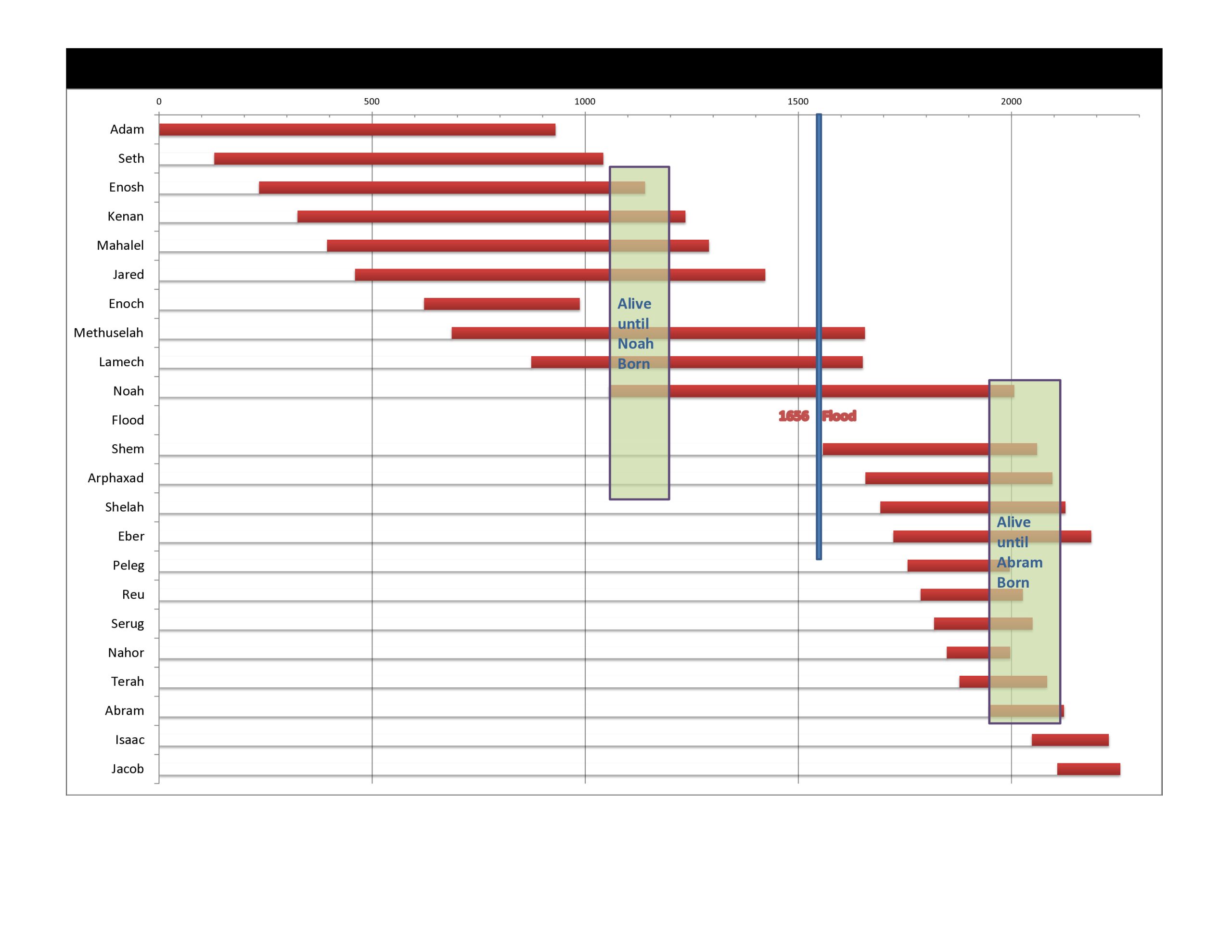
This chart traces the family lineage from Adam through the twelve sons of Jacob, showing the genealogical thread through which God worked to build the nation of Israel.
Why this chart matters
The purpose of this chart is to push back against the frequent argument that the history of the Old Testament was a case of “telephone” — accuracy being lost with each retelling.
This chart makes it clear that Noah would have heard about creation from Methuselah, who lived alongside Adam for more than two hundred years. And post-flood, Shem was alive to teach Abram, later Abraham.
Not “telephone.” In every case, close to first-hand.
Methuselah lived alongside Adam for over 240 years and alongside Noah for 600. One man knew both the first man and the man who carried the account through the flood. The creation account crossed one lifetime to reach Noah, not ten.
Enosh, three generations from Adam, was born while Adam still had 695 years to live and outlived the birth of Noah by 84 years — a second witness to the same span.
Shem lived 600 years and outlived Abraham. The man who came through the flood was still alive during the whole of Abraham’s life.
Methuselah, and the patience of God
There is more in that name than a record for old age.
Methuselah has long been read as carrying the sense “at his death it will come.” Whether or not the etymology can be pressed that far, the arithmetic of the chart is striking on its own: he was born in the year 687 from creation and lived 969 years (Genesis 5:27), which brings him to 1656 — the very year of the flood.
The longest life recorded in Scripture ends in the year judgment falls. And that is the point worth taking from it: his lifetime is the delay. He is a visual aid of God’s longsuffering — nine hundred and sixty-nine years of it, while the world went the way Genesis 6:5 describes.
A note on the name. The reading above is a well-known one and it fits the numbers exactly, but Hebrew scholars do not all agree on it — the first part of the name can also be read simply as “man of.” The chronology, however, is not in doubt.